

If you want the cheapest way to rent an RV for a month, peer-to-peer rental platforms like RVezy are the way to go. You can find rates as low as $2,250 per month and talk directly to owners to negotiate long-term discounts.
Traditional RV rental companies? They charge premium rates and tack on extra fees for mileage, kitchen kits, and bedding. Those extras can easily add $1,000 or more to your total bill.
Renting from individual RV owners gives you more flexibility to negotiate monthly rates, avoid unnecessary add-ons, and choose delivery options that save you time and money.

This guide is for budget-conscious travellers and families planning extended road trips. If you’re hoping to explore the Canadian Canadian Rockies without blowing your budget on an RV rental, you’re in the right place.
You’ll learn exactly how to find the lowest monthly rates, dodge hidden costs, and use some insider tricks that most rental blogs just don’t mention. These tips come straight from real RV rental experience—not just stuff you can read online.
Get ready to see why peer-to-peer platforms almost always beat traditional rental companies for affordability. You’ll spot hidden fees before you book, and figure out which type of RV actually gives you the best value for a month-long adventure.
Key Takeaways
- Peer-to-peer platforms like RVezy offer the lowest monthly RV rental rates and let you negotiate directly with owners
- Choosing the smallest RV that fits your needs and skipping expensive add-ons can save you over $1,000 per month
- Hidden fees for mileage, insurance, kitchen kits, and delivery can double your rental cost if you don’t plan ahead
This Post Is All About The Cheapest Way To Rent An RV For A Month
Disclosure: Some of the links in this post are ‘affiliate links’. This means if you click on the link and purchase the item, I will receive an affiliate commission.
How To Find The Cheapest Way To Rent An RV For A Month
If you want to find the cheapest way to rent an RV for a month, you need to compare peer-to-peer platforms, book well before peak travel times, pick only the RV size you really need, and check what’s actually included in your rental agreement. These moves can slash your monthly costs by 30-40% compared to grabbing something last-minute from a big rental company.
Compare Peer-To-Peer Rental Platforms
Peer-to-peer rental platforms connect you directly with RV owners. They usually charge 30-40% less than commercial rental companies.
RVezy is the biggest marketplace in Canada, with hundreds of privately owned motorhomes and camper vans at much lower daily rates. When you rent from an owner, you can often negotiate a discount for longer bookings.

Many owners actually prefer monthly rentals because they guarantee steady income and cut down on turnover hassles. Start by searching your pickup location, filter by price, and message several owners to ask about monthly discounts.
Key benefits of peer-to-peer platforms:
- Lower base rates than commercial fleets
- Flexible pickup and delivery options
- Direct communication with owners for custom arrangements
- Insurance included through the platform
Traditional rental companies like CanaDream and Fraserway keep their rates high because they maintain large commercial fleets. Their monthly rv rental costs usually include mandatory add-ons that really bloat your total price.
Peer-to-peer options mostly cut out those markups.
My family personally rented on RVezy before we bought our own travel trailer. It allowed us to experience RV ownership without the massive price tag.
Book Early And Avoid Peak Seasons
Book your monthly rv rental 3-6 months in advance to lock in lower rates before demand spikes. RV rental prices in Canada hit their peak during June, July, and August when families plan summer getaways.
If you plan your month-long trip for May, September, or October, you can save on daily rates. Booking early also gives you first dibs on available RVs.
The best-value units disappear fast, especially for long-term rentals. Wait until spring to book a summer rental and you’ll get stuck with whatever’s left—at top dollar, too.
Best months for cheap monthly rv rentals:
- April-May: Spring shoulder season
- September-October: Fall colours
- November-March: Winter rates (if travelling south)
Watch for early bird deals from RV owners who want to fill their calendars before the rush. Better yet, message them and look to negotiate.
We now have our trailer posted on RVezy and I have people reaching out all the time looking to negotiate price. My motto is…You don’t get what you don’t ask for!
Choose The Smallest Suitable RV
Pick the smallest RV that fits your needs—it’s honestly one of the fastest ways to cut your monthly rental cost. A compact camper van rents for $75-$140 per day, while a big Class A motorhome can run $200-$400 per day.
This is obviously market specific. The Canadian Rockies is a prime location and can demand a higher rate. Double check RVezy in your market for pricing.
RV size comparison for monthly rentals:
| RV Type | Daily Rate Range | Monthly Cost | Fuel Efficiency |
|---|---|---|---|
| Travel Trailer (2-10 people) | $75-$250 | $2,250-$7,500 | Best (depending on tow vehicle) |
| Camper Van (2- people) | $135-$395 | $4,050-$11,850 | Better |
| Class B/C (2-6 people) | $135-$450 | $4,050-$13,500 | Good |
| Class A (2-6 people) | $225-$360 | $6,750-$10,800 | Poor |
Be honest about how many people are coming and what you actually need in terms of space. A lot of renters book bigger units than they need, thinking they’ll want the extra room, and then regret the extra cost.
I am in the mindset that you just really sleep and cook in the RV. Most of your time is spent outside exploring. If you’re a family of 4 or 5, look for a unit that sleep 6 people. This will be a comfortable, good sized unit for your family.
Review Inclusions, Fees, And Restrictions
Read the fine print on your long-term RV rental agreement. It’ll save you from nasty surprise charges that can wreck your budget.
Check what’s included in the base rate and what costs extra. Standard inclusions usually cover basic insurance, kitchen gear, and unlimited kilometres, but many owners charge extra for bedding, camping chairs, bike racks, or generator use.
Common fees to watch for:
- Cleaning fee (usually $75-$150)
- Generator usage ($3-$5 per hour)
- Delivery and pickup ($1-$2.5 per kilometre)
- Propane refills ($50-$70 per 20lbs tank)
- Emptying Septic Tanks ($100-$180)
- Additional driver fees ($10-$15 per day)
- Late return penalties ($150 per hour)
Mileage limits matter for monthly rentals. Some owners cap daily kilometres at 150-200, which can really cramp your plans for longer trips.
Negotiate unlimited kilometres up front if you plan to cover a lot of ground. And if your location is within 100 km, ask for delivery—paying $200-$400 for delivery is usually better than losing half a day to pick up the RV and figure out its systems while rushed.
Insurance coverage changes from platform to platform and owner to owner. RVezy includes liability and collision coverage for every booking, but double-check your deductible.
Monthly RV Rental Cost Breakdown

Monthly RV rental costs range from $2,000 to $13,000, depending on what type of vehicle you pick. Smaller towable campers are the cheapest, while luxury motorhomes sit at the top end of the price scale.
Typical Monthly Rates By RV Type
Pop-up campers are the most affordable, running around $2,000 to $2,500 per month. These light units sleep two to four people and give you basic shelter, but not much in the way of separate living space.
Travel trailers cost around $2,250 to $7,500 monthly and can fit two to ten people. They offer more a lot more amenities than pop-ups, but you’ll need a vehicle that can tow them safely or get it delivered for a fee.
Class B camper vans are a drivable option if you plan of exploring more, at roughly $4,000 to $11,000 per month. They sleep 2 and are way better on fuel than larger motorhomes.
Class C motorhomes run about $4,000 to $13,500 monthly. These mid-sized units strike a good balance between space and maneuverability for families of two to six.
Class A motorhomes are surprisingly not at top of the price chart and cost roughly $6,500 to $10,500 per month. They sleep two to six guest and come with features like full kitchens and separate bedrooms.
How Much Does It Cost to Rent an RV for a Month?
RV rental prices are more than just the base rate—especially on platforms like RVezy.
Cleaning Fees:
These are set by the owner and usually range from $75 to $150, though some hosts waive this for longer rentals.
Insurance:
Expect to pay for protection coverage per night, typically around $20–$50/day, depending on the RV, location, and coverage level.
Mileage:
Most rentals include a set number of kilometres, but limits vary by owner. If you go over, expect to pay roughly $0.30 to $0.70 per km.
Service Fees:
RVezy charges a service fee based on your total booking, which varies depending on the trip. Additional charges (like extra mileage or cleaning) may include a small transaction fee.
Common Additional Costs:
- Security deposit: $500 to $1,500
- Roadside assistance: $5 to $20 per day
- Generator usage: $3 to $5 per hour (sometimes unlimited)
- Pet fees: $50 to $200 per rental period
- Delivery fees: $1-$2.50 per KM one way.
Monthly Discounts And Long-Term Savings
Monthly rentals usually save you 10% to 20% compared to daily rates. For example, a Class C motorhome that costs $200 a night drops to about $160 a night when you book for 30 days.
Private owners on peer-to-peer platforms often negotiate even better monthly rates than traditional rental companies. Sometimes you can score an extra 10% to 15% off just by messaging owners directly about an extended stay.
If you book off-season (October to April), you can save more compared to summer rates. Many owners like the steady monthly income during slower periods and price their RVs accordingly.
Book a round-trip from the same location to avoid one-way fees of $200 to $500. That one move can save you enough to cover several nights of camping fees.
Types Of RVs You Can Rent For A Month
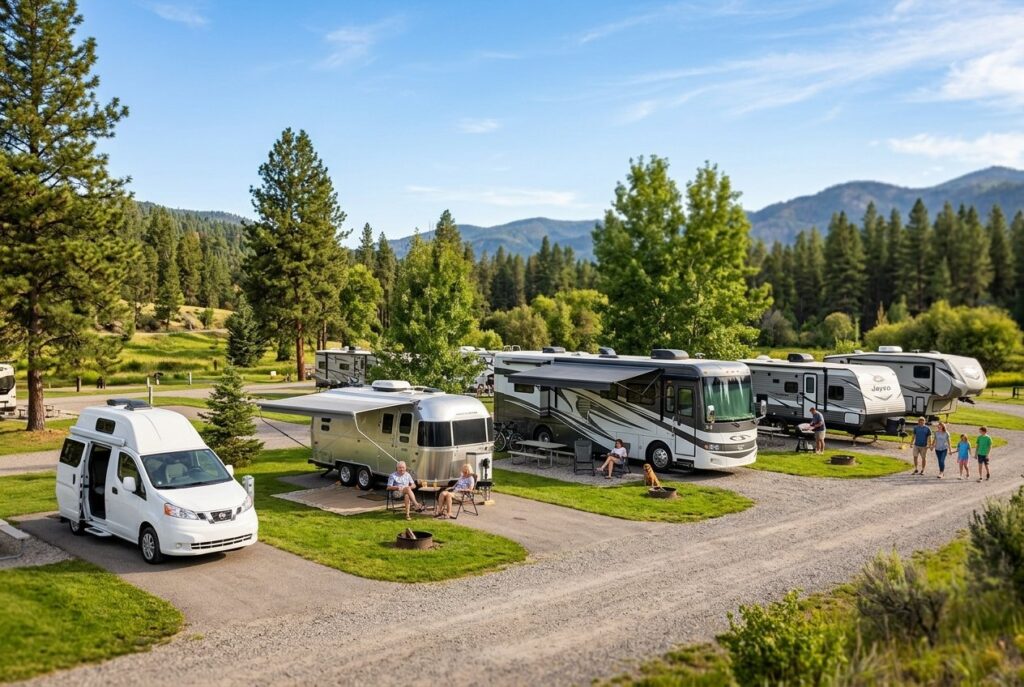
Different RV types come with different monthly rental costs. Picking the right one can save you hundreds of dollars, maybe even more if you’re clever about it.
Class A motorhomes give you the most space, but they’re definitely costly. On the other hand, travel trailers and campervans are the go-to for anyone watching their wallet.
Class A, B, and C Motorhomes
Class A motorhomes top the list for size and cost when it comes to monthly rentals. These beasts sleep 6-8 people, and you’re looking at roughly $310 per night—so about $9,300 a month, not counting any discounts you might wrangle.
You get a full kitchen, bathroom, and a ton of storage space. It’s basically a rolling apartment, though the price tag definitely reflects that.
Class B camper vans are way more compact and fuel-friendly. They’re great for couples or solo road warriors. At around $225 per night, you’re in for about $6,750 a month.
Driving and parking these is a breeze compared to the big rigs, and you’ll save a fair bit on gas, too. Sometimes, less is more, right?
Class C motorhomes are the most expensive due to popularity—think of them as the Gold standard. Different classes of motorhomes sleep 2-6 people, and you’ll pay approximately $200-$300 per night.
For a month rental, that’s $6,420-$7,350, though you can often talk owners down a bit if you’re booking through a peer-to-peer site.
Travel Trailers And Fifth Wheels
Travel trailers are hands down the best bang for your buck if you already own a tow vehicle. Nightly rates run around $100-$150, so a month will set you back $3,300-$4,500.
They sleep 2-10 people and let you unhitch and roam around without dragging your “home” everywhere. That’s a huge plus, honestly.
Fifth wheels need a pickup truck with a special hitch, but they give you even more living space than the average trailer. They cost a bit more, but still beat most motorhomes on monthly price.
Just remember, your truck’s fuel bill can get hefty if you’re covering long distances. It’s something people sometimes forget to budget for.
Both options let you negotiate lower rates since you’re not renting an engine and chassis from a big company. Plenty of owners on motorhome rental platforms knock off a chunk of the price for month-long trailer rentals.
Pop-Up Campers And Campervans
Pop-up campers fold down for easy towing and storage. They’re super affordable for monthly rentals, especially if you just need a spot to crash after a day outdoors.
If you’re planning to spend most of your time outside, these are a no-brainer. You’ll pay way less than you would for any motorhome.
Campervans (even smaller than Class B) have become wildly popular for budget monthly rentals. They’re easy to drive, fit in regular parking spots, and barely sip fuel compared to their bigger cousins.
Most campervans come with simple cooking setups and sleeping space for two or three people. Nothing fancy, but it gets the job done.
Both options really suit minimalists who don’t need a ton of room. You trade off some amenities and storage, but if you’re moving around a lot, the lower costs and better gas mileage make the cramped quarters worth it.
For a month-long trip, I’d argue the savings and flexibility often beat having more space—unless you’re traveling with a big group or just can’t live without a full bathroom.
Top Companies And Platforms Offering Monthly RV Rentals
Peer-to-peer platforms usually win on price since they connect you directly with RV owners. Traditional rental companies, meanwhile, offer more predictable pricing and service if that’s your preference.
Canadian renters can use both international platforms and local companies that really “get” long-term rentals. That’s a nice bonus if you’re north of the border.
Peer-To-Peer Options
Peer-to-peer RV rental platforms really open up your options for monthly discounts. You can chat directly with owners and often score deals that aren’t advertised.
There’s a huge range of RV types, from basic travel trailers starting at about $3,000 a month, all the way up to luxury motorhomes that’ll make your jaw drop.
Outdoorsy and RVshare are the big names in the United States. You can filter for monthly rentals and compare tons of listings in your area, which is honestly pretty convenient.
Owners set their own prices and fees, so sometimes you stumble onto a steal compared to the big rental companies. It takes a bit of digging, but it’s worth it.
Flexibility is the big win here. Many owners will drop delivery fees if you’re nearby, or toss in extras like camp chairs and cookware if you’re booking for a month.
You can message them directly and ask about 30-day discounts before you lock anything in. Don’t be shy—sometimes all it takes is asking.
What to watch for:
- Mileage limits (some include 100-200 kilometres per day, but others charge an average of $0.50 per extra KM, which adds up fast)
- Insurance options and what’s actually covered
- Add-on fees for stuff like linens, kitchen gear, and camping equipment
- Delivery costs if you can’t pick up the RV yourself
Major RV Rental Companies
Cruise America keeps things simple with monthly rates—Class C motorhomes start at about $3,600 per month. El Monte RV is in the same ballpark and has locations all over the continent.
These companies tack on extra mileage fees (usually $0.38 per mile), plus $75 per person for linens and $125 for kitchen essentials. It adds up quick if you’re not careful.
If you want predictable costs and don’t feel like haggling with owners, traditional companies are your best bet. But that $3,600 rental can balloon to $5,165 once you add all the extras for a family of four.
[Add Personal Experience: mention any experience comparing traditional company pricing to peer-to-peer options]
The upside? Consistency. You know exactly what you’re getting, and customer service follows company rules instead of one owner’s quirks.
Fleet vehicles get regular maintenance and inspections, which gives you peace of mind if you worry about breakdowns.
Renting An RV In Canada
Canadians have a few homegrown rental companies, like CanaDream, Fraserway RV, and Four Seasons RV Rentals. These folks really know the Canadian market and have pickup spots in all the major cities and tourist hotspots.
CanaDream runs one of Canada’s biggest fleets and offers monthly rates with seasonal deals. Fraserway RV has similar services in British Columbia, Alberta, and Ontario.
Four Seasons RV teams up with international booking sites, so they reach more renters. That’s handy if you’re coming from abroad or just want more choices.
International platforms work well for Canadians, too. You’ll see hundreds of privately owned RVs listed across the provinces, and sometimes you’ll find better deals than the big fleets.
If you’re flexible about the RV type and pickup location, you’ll have way more options for monthly rentals. That’s worth keeping in mind.
Additional Fees, Insurance, And Hidden Costs
When you rent an RV for a month, that daily rate is just the teaser. Mileage caps, insurance upgrades, and campground fees can pile up fast if you’re not paying attention.
Mileage, Cleaning, And Add-On Charges
Most rentals include a mileage limit—usually 100-200 kilometres per day. If you go over, expect to pay $0.50-$1.00 per extra kilometre.
Some owners on peer-to-peer rental platforms offer unlimited mileage for a flat fee. That’s perfect if you’re planning a big cross-country trek.
Cleaning fees range from $75-$200, depending on RV size and what you agree on. Many owners skip this fee if you bring the RV back spotless, which is fair.
Generator use usually runs $3-$5 per hour. If you’re boondocking a lot, that adds up surprisingly fast.
Add-ons like kitchen kits, bedding, or bike racks cost $50-$150 per month. Always double-check what’s included—sometimes you can talk the owner into tossing in these extras for free if you’re renting for a month.
Insurance Coverage For Monthly Rentals
Basic liability insurance is usually baked into your rental price, but it only covers damage to other people’s stuff. You’ll need extra coverage for damage to the RV itself, which can run $15-$50 per day through rental companies.
On peer-to-peer platforms, full insurance packages usually cost $500-$1,000 per month. These cover collision, fire, theft, and roadside help.
Check if your own auto insurance covers RV rentals before you pay for double coverage. Some credit cards offer rental insurance, but most don’t cover RVs over a certain size—read the fine print, seriously.
Skipping insurance to save a few bucks is risky. One accident could cost you $10,000-$50,000 out of pocket, and that’s not a fun surprise.
Campground Fees And Overnight Stays
Campground fees can easily become your biggest ongoing expense during a month-long RV adventure. Full-service RV parks with hookups cost $40-$150 per night, or $1,200-$4,500 a month.
Provincial and national parks are cheaper at $25-$50 per night, but they usually cap you at 14 days per campground. You’ll have to move around to stay legal.
If you’re up for free camping on Crown Land or using apps like iOverlander or Backroad Maps, you can bring your accommodation costs to zero. Just remember, no hookups means more propane, battery use, and careful water management.
Monthly campground rates give you the best value if you’re sticking around one spot. Plenty of private RV parks offer $600-$1,200 monthly rates with all the hookups, which can save you 30-50% compared to paying nightly.
Proven Tips To Save Money On Your Month-Long RV Rental
Want to save big? Time your rental right, skip the unnecessary extras, and think about your pickup arrangements. You might be surprised how much you can shave off your monthly RV rental bill.
These tricks work whether you’re booking through peer-to-peer platforms or the big traditional companies. There’s always a way to cut costs if you’re persistent.
Rent Off-Peak And Watch For Deals
Renting in peak summer (June through August) could cost you 10% to 20% more than shoulder seasons. If you can swing it, travel in April, May, September, or October for way lower rates and better selection.
Monthly discounts usually knock 10-20% off nightly rates. Sometimes owners go even lower if you’re booking for a longer stretch.
If you’re using a peer-to-peer platform, don’t be afraid to negotiate. The listed price is rarely the final word on a month-long rental.
Best times to find cheap RV rental deals:
- April to May: Spring shoulder season, nice weather, and fewer crowds
- September to October: Fall colors and even fewer people
- November to March: Cheapest rates, but you’ll have to deal with cold and maybe snow
Winter rentals in warmer spots like coastal BC can be a steal. You get off-season prices but still have decent weather—kind of the best of both worlds.
Bring Your Own Supplies And Avoid Extras
Bedding cost anywhere from $50 to $75. Fire bowls usually run $50 to $70. It’s wild how fast those fees pile up.
I always pack my own bedding, towels, cookware, and camping chairs from home. Most RVs use standard-sized beds, so your regular sheets will probably fit just fine. Tossing in a few basic cleaning supplies can help you sidestep those annoying cleaning fees at return.
Going on networks like RVezy, you can find RVs that offer some of the amenities for free or are willing to negotiate.
Generator rental? That’ll set you back $25 to $100 per day, or $3 to $5 for every hour you use it. If you stick to campgrounds with electrical hookups, you can skip the generator completely. Ask owners which campsites along your route actually offer full hookups—don’t just assume.
Pet fees can range from $5 to $15 daily, or $50 to $200 as a flat rate. If you’re traveling with pets for an entire month, try negotiating a reduced monthly pet fee instead of just accepting the daily charges. Owners are usually open to it if you ask.
Consider A Round-Trip Instead Of One-Way Rental
One-way rentals tack on $200 to $500 (sometimes more!) in drop-off fees. Owners add these to cover the hassle and cost of retrieving their vehicle from a far-off spot.
Round-trip rentals? You can skip that expense entirely. Plan a loop route so you end up back where you started. So many Canadian road trips work as loops—Vancouver to the Rockies and back, or a Maritime provinces circuit, for example.
Some owners offer delivery and pickup for $100 or more each way. Sounds pricey, but it can actually save you money if it lets you dodge one-way fees and rental car costs just to get to the pickup location.
Cost comparison for a month-long rental:
- Round-trip rental: Base rate only
- Delivery option: Base rate + $175-$800+ total (both ways)
Frequently Asked Questions
Monthly RV rental costs depend on a bunch of factors: RV type, rental platform, mileage limits, and all those extra fees that sneak up on you. If you understand these variables, you can budget more accurately and avoid nasty surprises.
What factors have the biggest impact on the total monthly cost of an RV rental?
The type of RV you pick changes your monthly cost more than anything else. A pop-up camper or teardrop trailer usually costs less per month, but a Class-A/B/C motorhome can hit harder monthly. Ouch.
Your rental platform really matters, too. Peer-to-peer rental platforms usually offer lower base rates than the big corporate rental companies, since you rent directly from owners who want to stay competitive.
Seasonal timing makes a big difference. If you rent during shoulder seasons or winter, you could save compared to peak summer rates. Location matters, too—rentals in popular tourist areas cost more, obviously.
Campground fees can add up fast over a month. Budget $40 to $80 per night for standard campgrounds, or just find free boondocking sites and skip the expense entirely. It’s not for everyone, but it works.
How far in advance should I book to get better monthly RV rental rates?
If you book 3-4 months ahead, you’ll usually get the best selection and pricing. There are just more RVs to choose from, and you can negotiate better with owners on peer-to-peer platforms.
Last-minute bookings (within 2-4 weeks) sometimes land you deals if owners want to fill empty spots, but your options will be limited—especially during peak season. It’s a gamble.
Booking early also could lock in lower rates before prices jump for popular dates. A lot of RV owners bump up their prices as demand rises closer to summer or holidays.
Are long-term RV rentals cheaper through peer-to-peer platforms or traditional rental companies?
Peer-to-peer platforms almost always offer lower monthly rates than traditional rental companies. The cheapest way to rent an RV is to use these platforms, where owners compete on price. It’s just more flexible.
Traditional companies like Cruise America charge premium rates and usually include fewer amenities in the base price. You’ll end up paying extra for kitchen kits, bedding, and other basics that peer-to-peer rentals often throw in for free.
Peer-to-peer platforms let you negotiate monthly discounts directly with owners. Many will offer 10-20% off their nightly rate for a full month, since it guarantees them steady income. It’s a win-win.
Delivery options on peer-to-peer platforms can save you even more by cutting out pickup fees and fuel costs for retrieval. Some owners will just deliver the RV to you for a reasonable flat fee—super convenient.
Which fees are commonly added on top of the advertised monthly rate, and how can I minimise them?
Mileage fees are one of the biggest hidden costs. Many rentals include 100-200 kilometres per day, then charge for every extra kilometre. Map out your route in advance and pick rentals with unlimited or generous mileage if you can.
Generator usage fees usually run $3 to $5 per hour. You can minimize these by sticking to campgrounds with electrical hookups, or using solar panels if you’re boondocking. Sometimes it pays to be a little scrappy.
Cleaning fees can be expensive depending on RV size. If you return the RV clean (and follow the owner’s checklist), you can usually avoid these. It’s worth the extra effort.
Preparation and admin fees from traditional companies add $50 to $150 to your bill. Peer-to-peer platforms rarely tack on these administrative charges, which is a relief.
Insurance costs vary a lot based on coverage. Basic plans start around $15 per day, while comprehensive coverage can reach $40+ daily. Sometimes your personal auto insurance or credit card covers RV rentals, so check before paying extra.
What insurance options are available for a month-long RV rental in Canada, and what do they typically cover?
Most Canadian RV rental platforms include basic liability coverage in the rental price. That usually covers $1-2 million in third-party liability, but the deductible is steep—$3,000 to $7,500.
Comprehensive damage protection lowers or eliminates your deductible, but it costs $15 to $40 per day. For a month, that’s an extra $450 to $1,200. Not exactly pocket change.
Roadside assistance coverage means towing, tire changes, and emergency repairs. A lot of platforms throw this in automatically, but traditional rental companies often charge extra for 24/7 support. It’s worth asking about.
Personal effects coverage protects your stuff inside the RV. Check if your home or renter’s insurance already covers this before you double up on coverage you don’t need.
Some credit cards offer collision coverage for RV rentals, but make sure the policy actually includes recreational vehicles. Many card benefits exclude vehicles over a certain size or weight, which is frustrating.
How do mileage limits and fuel costs affect the overall cost of a month-long RV trip?
Mileage limits can really jack up your total cost if you’re planning to cover a lot of ground. For example, if you drive 1,000 kilometres beyond your limit and the fee’s $0.50 per kilometre, you’re suddenly staring at an extra $500 on your rental bill.
Fuel consumption? That swings wildly depending on your RV. Class-A motorhomes burn through 20-30 litres every 100 kilometres, while those smaller Class-B vans guzzle more like 12-18 litres per 100 kilometres.
If you’re doing a 3,000-kilometre journey in a Class-A, you might shell out $900-1,350 just on fuel. That’s not a small line item.
When you stick to a local area or set up a home base, you chop down both mileage fees and fuel costs by a lot. I’ve found you’ll usually save a good chunk by really getting to know a smaller region instead of trekking coast to coast.
Fuel type matters, too. Diesel engines usually squeeze out better mileage, but diesel itself costs a bit more per litre in most Canadian provinces.
Try to map out your route so you’re not doubling back or racking up pointless kilometres. Every 100 kilometres you skip means you keep more cash in your pocket—both on fuel and those annoying overage charges.