
Finding the best RV solar panel kit means you can power your appliances and devices while camping off-grid—no noisy generator required. You gain independence from crowded campgrounds when you invest in a high-quality RV solar kit.
Some of my favorite RV solar kits for 2026? The Callsun N-Type 400 Watt Kit if you want durability and high output, the Renogy 100 Watt Starter Kit for those just starting out, and the ECO-WORTHY 1200W Complete Kit for folks with serious off-grid power needs.
These solar panels convert sunlight into usable electricity for your RV. You can run lights, fans, refrigerators, and even air conditioners if you size things right.
Picking the right solar kit really depends on how much power you need, your budget, and whether you want a portable or roof-mounted system. You’ll need to get a handle on the basics: solar panels, charge controllers, batteries, and inverters—otherwise, your system might not work for your travel style.
Some kits come with everything in the box, but others make you buy batteries separately. It’s worth double-checking what’s included before you hit “buy.”
This guide breaks down what makes a good RV solar kit. I’ll compare different panel types and power outputs, and point out the best options based on real-world testing.
You’ll find tips for calculating your power needs, sidestepping common installation mistakes, and squeezing the most from your investment—whether you’re a weekend camper or living full-time on the road.
Key Takeaways
- Solar panel kits range from 100-watt starter systems for basic needs to 1200+ watt setups that can run air conditioners and major appliances.
- Monocrystalline panels cost more but give you the most power per square foot. Polycrystalline panels offer better value for casual users.
- Complete kits include panels, charge controllers, and mounting hardware, but you’ll usually need to buy batteries separately based on your storage needs.
This Post Is All About The Best RV Solar Panel Kit
Disclosure: Some of the links in this post are ‘affiliate links’. This means if you click on the link and purchase the item, I will receive an affiliate commission.
What Is an RV Solar Panel Kit?
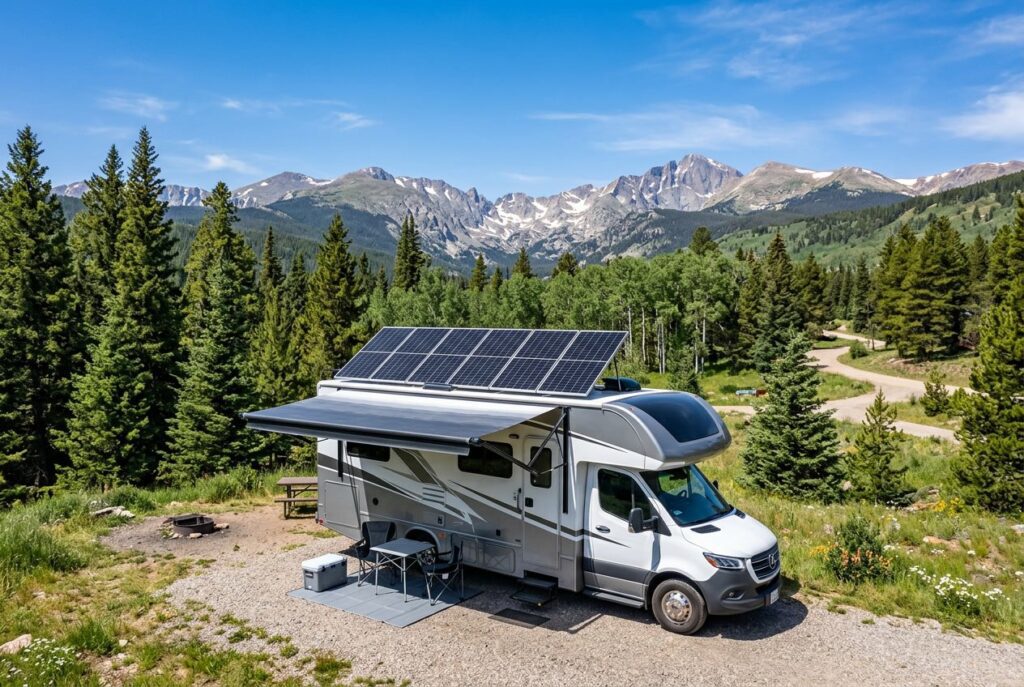
An RV solar panel kit bundles the main components you need to generate and store solar power in your camper. No need to hunt down each part separately.
You’ll find kits ranging from basic setups with just panels and a charge controller, to complete systems that throw in batteries and inverters.
Key Components of a Solar Panel Kit
Basic RV solar panel kits usually come with solar panels, a charge controller, mounting brackets, wiring, and fuses. The solar panels grab sunlight and turn it into electrical current.
Your charge controller regulates that power so your batteries charge safely—no overcharging headaches here.
Most higher-quality RV solar kits use rigid monocrystalline panels, which typically last 25–30 years. While flexible panels are lighter and easier to install, they usually only last 5–15 years—making rigid panels the better long-term value for most RV setups
You’ll see charge controllers labeled PWM or MPPT. Go for MPPT if you can—it’s up to 30% more efficient, especially with larger solar arrays.
Complete solar kits toss in batteries and an inverter, too. Your batteries store the power your panels generate each day.
The inverter flips 12V DC power from your batteries into 120V AC power for regular household appliances.
How RV Solar Panel Kits Work
Your solar panels generate DC electricity when sunlight hits them. This electricity flows through the charge controller, which steps down the voltage to fit your battery bank’s charging needs.
Your batteries store that energy for later—at night, on cloudy days, or when you’re tucked away in the shade. If you want to run AC appliances like a laptop or coffee maker, the inverter converts that stored DC power into AC power.
The system works best with direct sunlight. Even a little shade from tree branches can cut output way down, so where you mount your panels matters just as much as the kit you buy.
Types of RV Solar Panel Kits
Basic kits give you the solar panels, charge controller, and mounting hardware. You’ll need to pick up batteries, an inverter, and extra wiring yourself.
These work well if you’ve already got some components or want to mix and match brands for each part.
Complete kits include everything—panels, charge controller, batteries, inverter, and all the wiring you need. Complete solar panel kits cost more upfront, but you won’t have to worry about compatibility headaches between components.
Portable power stations are plug-and-play. No installation, no drilling. Just set them inside your RV and charge them up with portable or roof-mounted panels.
I think they’re perfect for weekend campers who don’t want to drill holes in their roof or mess with permanent wiring.
How to Choose the Best RV Solar Panel Kit
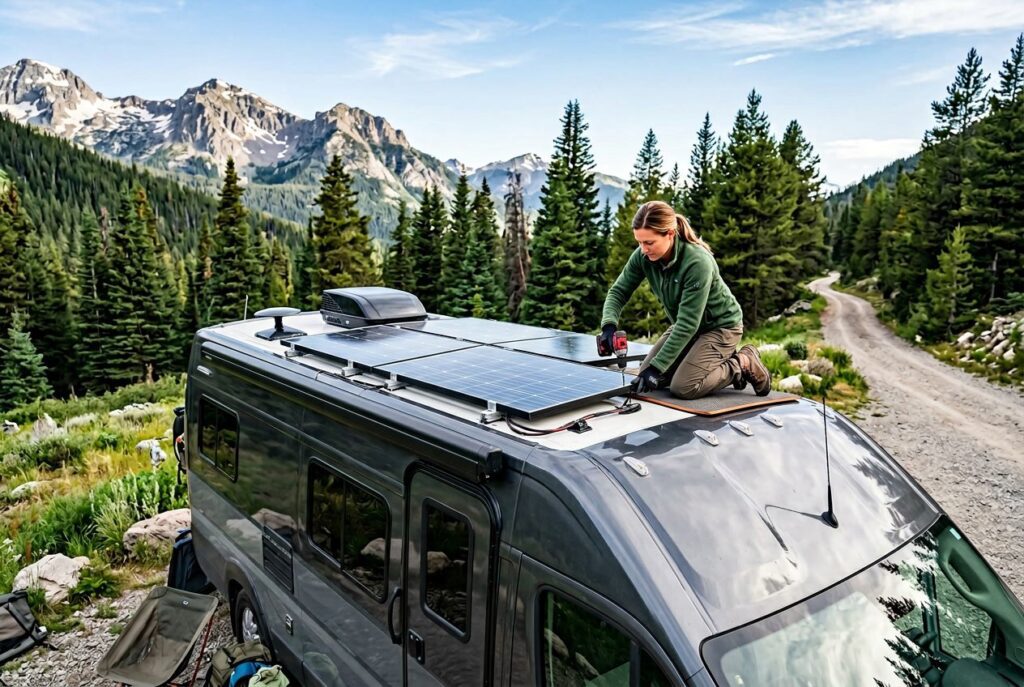
Selecting the right solar kit starts with calculating your daily power consumption. You’ll also want to figure out which panel technology fits your roof space and budget, and match your components to your battery bank capacity.
Your choices around panel efficiency, controller type, and system size really determine whether you’ve got enough power for a weekend trip or can actually live off-grid for weeks.
Assessing Your Power and Battery Needs
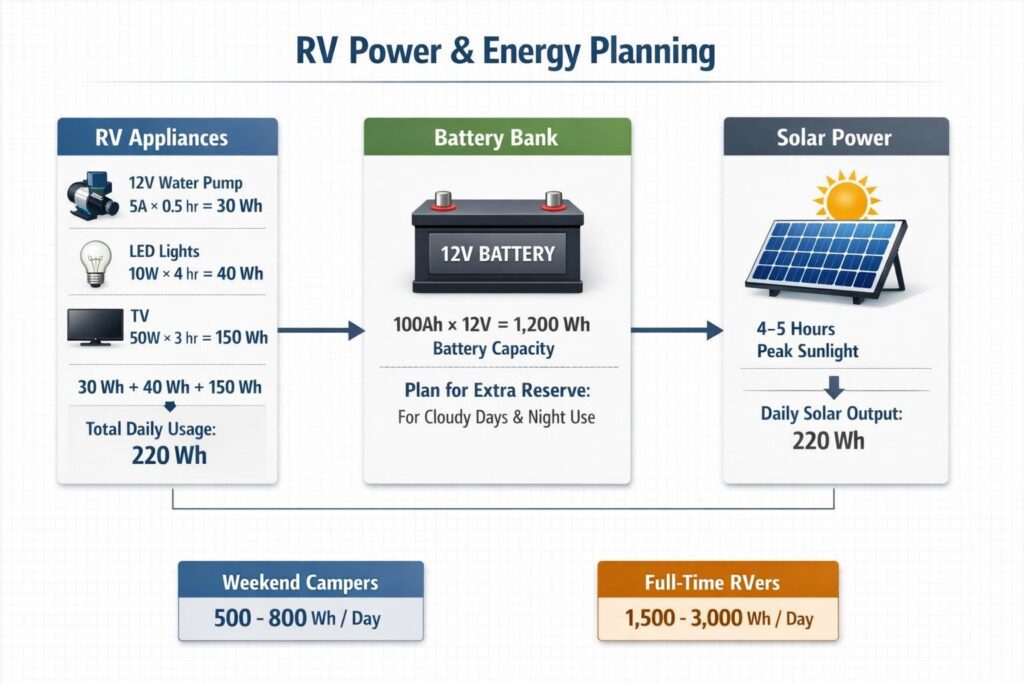
Start by figuring out your daily power use in watt-hours. List every device you’ll run off solar and multiply its wattage by hours of use each day.
For example, a 12V water pump drawing 5 amps for 30 minutes daily uses 30 watt-hours. Got LED lights running 4 hours at 10 watts? That’s 40 watt-hours. A TV at 50 watts for 3 hours chews through 150 watt-hours.
But what is the differences between Volts, Amps, and Watts (Watt Hours)?
Here is a clear breakdown to help!
| What You Have | Formula | Example | Result |
|---|---|---|---|
| Amps → Watts | Watts = Volts × Amps | 12V × 5A | 60W |
| Watts → Watt-hours | Watt-hours = Watts × Hours | 60W × 0.5h | 30Wh |
| Amps → Watt-hours (1 step) | Wh = Volts × Amps × Hours | 12V × 5A × 0.5h | 30Wh |
| Watts → Amp-hours | Ah = Watts ÷ Volts | 300W ÷ 12V | 25Ah |
| Watt-hours → Amp-hours | Ah = Wh ÷ Volts | 300Wh ÷ 12V | 25Ah |
So now that you know the differences and formulas, you want to add everything up for your daily baseline. You can also use a solar calculator to estimate your total energy requirements if you don’t want to do the math by hand.
Your battery storage capacity should be bigger than your daily use to handle cloudy days and nighttime. Battery banks are measured in amp-hours, but you convert to watt-hours by multiplying by voltage (12V system: 100Ah × 12V = 1,200 watt-hours).
Weekend campers usually need 500–800 watt-hours daily. Full-time RVers can require 1,500–3,000 watt-hours, depending on what you’re running.
Match your solar panel output to generate at least your daily use during 4–5 hours of good sunlight.
Understanding Panel Types: Monocrystalline, Polycrystalline, and Bifacial
Monocrystalline solar panels give you 20–22.5% efficiency and do better in low-light than other types. They cost more, but if you’re short on roof space, you’ll want to maximize every watt per square metre.
These panels look uniform and black, and they handle heat better than the alternatives.
Polycrystalline solar panels offer 15–17% efficiency and cost less. They’re blue, and honestly, if you’ve got a big roof, they work just fine.
The efficiency difference doesn’t matter much on bigger RVs where you can just add more panels to make up the gap.
Bifacial solar panels grab sunlight from both sides, which can boost output by 10–20%. They work great on white RV roofs, but they’re pricey.
Most RVers probably don’t need this tech unless you’re really chasing every last watt.
Flexible solar panels weigh less and fit curved roofs, but they usually last just 2–5 years compared to 25+ years for rigid panels. I’d only use them for temporary setups or weird mounting spots where rigid panels just won’t work.
Sizing Your RV Solar Setup
To size your solar array, divide your daily watt-hours by the average peak sun hours in your area. Say you need 1,200 watt-hours daily and get 5 peak sun hours—that’s at least 240 watts of panels (1,200 ÷ 5 = 240).
I’d add 25–30% extra to cover efficiency losses, cloudy weather, and panel angle issues. So that 240-watt setup should really be a 300–320 watt system.
Your RV solar setup has to match your battery bank voltage. Most RVs use 12V systems, but bigger rigs sometimes run 24V or even 48V setups.
Double-check that your charge controller supports your battery bank size and chemistry type.
Think about expandability when you’re choosing panel kit sizing and components. Starting with 200 watts and growing to 400 later saves money upfront and leaves room to grow if your needs change.
Key Features to Look For
MPPT charge controllers pull in 15–20% more power than PWM controllers, especially in cold weather or when your panels run below their best voltage. They cost more, but I’d argue they pay for themselves over time.
PWM controllers are fine for small systems under 200 watts where price is the main concern.
Bluetooth monitoring lets you check power production, battery status, and system health from your phone. It can help you tweak panel angles and spot problems before they get serious.
Look for panels tested to withstand at least 2,400Pa wind pressure and 5,400Pa snow loads. Corrosion-resistant aluminum frames and IP65-rated junction boxes keep your investment safe from the weather.
Warranty coverage says a lot about the manufacturer’s confidence. Good panels offer 10–25 year material warranties, and controllers should come with 2–5 years. Shorter warranties? Usually a red flag for lower-quality gear.
Complete kits should come with mounting hardware, the right gauge wiring, MC4 connectors, and fuses. Getting everything from one place saves a ton of time and avoids compatibility headaches.
Essential Components and Accessories
A complete RV solar setup needs more than just panels. The right charge controller protects your batteries and helps you squeeze out the most power, while a quality inverter turns stored energy into usable household power.
And don’t forget: proper mounting hardware keeps everything secure when you’re bouncing down the road. Sometimes it’s the little things that save you the most headaches.
Solar Charge Controllers: PWM vs MPPT
Your solar charge controller sits right between your panels and batteries. It keeps your batteries from overcharging and manages the power flow.
A PWM solar charge controller is the simpler, cheaper option. It pulls down your panel voltage to match the battery voltage.
Sure, a PWM charge controller isn’t as efficient as an MPPT, but it’s still a go-to for folks trying to save money on the road.
MPPT solar charge controllers use maximum power point tracking to squeeze out better efficiency. They take any extra voltage and turn it into more current for your batteries.
This difference really shows up in cold weather or if your RV solar panels put out high voltage. MPPT charge controllers cost $150-$400, but if your system is over 400 watts, they pretty much pay for themselves.
Choosing PWM vs MPPT comes down to system size. If you’re running just 100-200 watts, a PWM controller saves cash without much loss in performance.
But once you get to 400+ watts, an MPPT controller earns back its higher price with better power harvest.
Inverters and Power Conversion
A solar inverter flips your 12V DC battery power into 120V AC, so your appliances actually work. Picking the right inverter to pair with your controller helps you get clean, reliable power.
Pure sine wave inverters deliver power that’s just like what you get from the grid. They’re a must for sensitive gear—laptops, CPAPs, newer TVs. Modified sine wave inverters cost less, but they can fry electronics or make your speakers buzz. Not really worth the risk, in my opinion.
Size your inverter for your biggest simultaneous power draw. A 1000-watt inverter can run a microwave or coffee maker, no problem.
Go for a 2000-watt if you want to run several things at once. If you need to run an AC or big appliances, a 3000-watt inverter is the way to go.
Look for inverters with built-in protections—overload, overheating, low voltage cutoff. Remote displays are handy so you don’t have to crawl into a compartment just to check usage.
Some models even throw in a battery charger for when you’re plugged into shore power, which is honestly a nice touch.
Mounting and Connection Hardware
Good mounting keeps your panels on the roof when you’re flying down the highway or when storms hit. Z brackets are the classic choice—they bolt to your RV roof and hold panels at a slight tilt for water runoff.
Most RV solar panel kits include mounting brackets that fit their panel sizes. Double-check that your brackets work for your roof—rubber and fiberglass need different fasteners.
Slap on self-levelling lap sealant around every bolt hole to keep leaks away. It’s a little messy but totally worth it.
MC4 connectors have become the industry standard for hooking up panels. They’re waterproof and snap together with a satisfying click—honestly, it’s kinda fun.
Don’t cut off the factory MC4 connectors. Use extension cables to keep everything weatherproof.
Tray cables (solar cables) run from your panels to the charge controller. Use 10 AWG for under 15 feet, 8 AWG if you need to go further. Thin wire causes voltage drop and wastes power, which nobody wants.
Pop an inline fuse between your panels and controller to protect against shorts. Install it within 18 inches of your battery’s positive terminal.
Pick a fuse that’s rated about 25% higher than your controller’s max current. Better safe than sorry.
Top Types of RV Solar Panels and Kits
RV solar setups really fall into three main types based on how you mount and use them. Rigid panels give you the most power for permanent roof installs, flexible panels work for curved roofs, and solar generators are super convenient—no install needed.
Rigid and Fixed Solar Panels
Rigid solar panels bolt down to your RV roof and give you the most consistent power. These use monocrystalline or polycrystalline cells in sturdy aluminum frames with tempered glass on top.
Monocrystalline panels cost more, but they’re more efficient and handle shade or clouds better. They use purer silicon, which helps. Polycrystalline panels are cheaper, but you’ll need more roof space to get the same output.
Most rigid panels run from 100 to 400 watts each. A 200-watt panel gives you roughly 1,000 watt-hours per day in full sun, give or take.
You’ll need mounting brackets, cables, and a charge controller to hook everything up to your battery bank.
Key advantages:
- Highest power output per square metre
- Stand up to harsh weather and high winds
- Last 25+ years—maintenance is minimal
- Best bang for your buck if you’re a full-time RVer
Drawbacks:
- Need to drill into your roof for install
- Add permanent weight to your rig
- You can’t tilt or move them for better sun angles
Flexible and Portable Solar Panels
Flexible solar panels bend to fit curved RV roofs, slide-outs, or weird surfaces. They’re lighter than rigid panels and stick on with adhesive—no bulky hardware needed.
They work great on fiberglass roofs where drilling would be a pain. Usually, they weigh 60-70% less than rigid panels with the same wattage.
Downside? They get hotter since there’s no airflow underneath, so they make a bit less power.
Portable solar panels sit on the ground next to your RV and connect with extension cables. Foldable solar panel kits pack up like a briefcase, which is honestly super handy.
You can angle them toward the sun as it moves, which can boost your power by 20-30% compared to fixed panels.
Best uses for flexible panels:
- Weekend campers who just need a little juice
- Vans with tricky roof space
- Adding on to an existing solar setup
Best uses for portable panels:
- Shady campsites under trees
- Trying out solar before committing to a full install
- RVers who move around a lot
Solar Generator and Power Stations
Portable power stations bundle a battery, inverter, and charge controller into one box. You can charge them from solar panels, your vehicle, or shore power. No installation needed—just plug and go.
Popular models from brands like Jackery, EcoFlow, and Bluetti run from 500 to 3,000 watt-hours of storage.
A 1,000-watt-hour station can run a 12-volt fridge for 10-15 hours, or charge your laptop and phone a bunch of times.
Pair these with portable solar panels to recharge during the day. A 200-watt panel will refill a 1,000-watt-hour station in 6-8 hours of strong sun, give or take.
Major benefits:
- No wiring or electrical knowledge needed
- Move them between your RV, tent, or even use for home backup
- Built-in outlets for both AC and DC stuff
- Expandable with extra battery packs
Limitations:
- Cost more per watt than a traditional system
- Can be heavy—larger models weigh 13-30 kg
- Not as expandable as a custom install
Honestly, these work best for occasional campers or renters who can’t drill holes in their RV roof.
Batteries and Energy Storage for RV Solar
Lithium batteries last longer and perform better than old-school AGM types. Planning your battery capacity and using a monitor keeps you from running out of power midway through a trip—nobody wants that.
Lithium vs AGM and Lead-Acid Batteries
Good RV batteries—especially lithium—cost more up front but pay off in the long run. A 100Ah lithium battery gives you 1,280Wh of usable storage and might last 3,000 to 15,000 cycles.
AGM batteries usually only give you about 50% usable capacity and wear out after 300 to 500 cycles. That’s a pretty big difference.
If you’re watching your RV’s weight, lithium batteries come in at about half the weight of lead-acid for the same capacity.
Key differences:
- Lithium: Charges fast, works in freezing temps, and you can drop them to 10% before risking damage
- AGM: Slower charging, needs ventilation, and don’t let them drop below 50% charge
- Lead-acid: Cheapest, but heavy and doesn’t last long
[Add Personal Experience: Share what battery type you use in your RV, how it performs during extended boondocking, and whether the cost difference was worth it]
Brands like Battle Born offer 10-year warranties, which is pretty reassuring. AGM batteries usually top out at two or three years of warranty coverage, so you can see why people lean toward lithium if they can swing the cost.
Capacity, Monitoring, and Upgrades
Figure out your daily power needs before you pick a battery size. Add up the watt-hours your fridge, lights, and devices use in a typical 24-hour stretch.
Most weekend RVers get by just fine with 100Ah to 200Ah of lithium storage. It’s usually enough unless you’re running heavy stuff like an AC all day.
A battery monitor gives you a real-time look at your state of charge, voltage, and how much power you’re pulling. These gadgets connect to your phone via Bluetooth or Wi-Fi, which is super handy.
You’ll know exactly when it’s time to fire up the generator or cut back on usage. No more guessing or getting caught off guard.
Common capacity guidelines:
| RV Use | Recommended Capacity |
|---|---|
| Weekend trips | 100Ah lithium |
| Week-long stays | 200Ah lithium |
| Full-time living | 300Ah+ lithium |
You can usually add more batteries to most systems later. Just connect them in parallel to boost capacity without changing voltage.
Try to match all your batteries in type, age, and brand for best results. Mixing and matching can lead to headaches down the road.
Installation, Maintenance, and Performance Tips
If you install your system correctly, it’ll run safely and efficiently. Regular maintenance stretches out the life of your panels and saves you from expensive repairs.
Knowing when to call in a pro versus tackling it yourself can save money and still keep things up to code. Sometimes, it’s just not worth the stress to DIY everything.
DIY vs Professional RV Solar Installer
Installing an RV solar system yourself can save you hundreds or even thousands in labor. Most basic kits with roof-mounted panels take maybe 4-6 hours if you’re okay drilling into your roof and messing with electrical stuff.
Renogy solar kits usually come with pretty solid instructions, so DIY installation isn’t as intimidating as it sounds. You’ll want a drill, wire strippers, sealant, and a multimeter to double-check connections.
The trickiest bit? Making weatherproof holes in your roof without turning it into a leaky mess. That part always makes me a little nervous, honestly.
Hiring an RV solar installer is the way to go if you’re not comfortable on the roof or just don’t want to mess with electricity. Professional installation runs $200-$800, depending on how complex your setup gets.
They’ll make sure everything meets local codes and keeps your warranty intact. Peace of mind can be worth the price sometimes.
Some manufacturers get picky about warranties if you mess up the install, so always read the fine print before you start.
Maximizing Output and Efficiency
If you point your panels south (in the Northern Hemisphere), you’ll catch the most sunlight throughout the day. Tilting them 15-30 degrees above flat boosts output by 10-25%, especially in winter when the sun’s lower.
Keep your solar cables short to cut down on voltage drop. Use 10 AWG wire for runs under 20 feet, and 8 AWG if you need to go longer.
Good MC4 connectors help prevent connection failures that can drag down your system’s efficiency. Don’t cheap out here—it’s not worth the headaches.
Wash your panels every month with water and a soft brush. Dust, bird droppings, and tree sap can zap your output by 20-30%, which is way more than people expect.
An HQST solar panel with a corrosion-resistant frame handles salty coastal air way better than bargain brands. That’s something I wish I’d known sooner.
It’s actually more important to keep panels out of tree shade than to nail the perfect angle. Even a bit of shade on one panel can tank your total output by 40-80%—depends how you’ve got them wired.
Durability, Weather, and Maintenance Considerations
The best solar panels for RVs use tempered glass and aluminum frames that handle hail, wind, and wild temperature swings. Check your mounting bolts every few months—driving rattles them loose over time.
The Go Power! Weekender kit comes with weather-resistant parts built for life on the move. Check all your roof holes twice a year and slap on more sealant if needed to keep water out.
Seriously, use a good RV-rated sealant instead of random hardware store caulk. I learned that the hard way.
Battery terminals get crusty and corroded after a while, which kills charging efficiency. Clean them every 3-4 months with a wire brush, then hit them with anti-corrosion spray.
Double-check your charge controller settings as the seasons change, since temperature can mess with how your batteries charge.
Your panels should last over 25 years if you keep up with basic maintenance, though output drops about 0.5% a year. Controllers and inverters usually need swapping out after 10-15 years.
Stash portable panels inside when you’re driving on the highway so they don’t get wrecked by the wind. Flexible panels on curved roofs tend to last 5-10 years, while rigid glass ones can go 25+ if you treat them right.
Recommended Best RV Solar Panel Kits for 2026
There are some standout kits that deliver reliable off-grid power for different budgets and needs. Your best pick depends on how much juice you want, how you plan to install, and whether you care more about portability or a permanent setup.
Best Overall and Premium Picks
The Callsun 400W Solar Panel Kit (4x100W) delivers high-efficiency off-grid power with advanced N-Type monocrystalline cells and up to 25% conversion efficiency. Compact, durable, and built with 16BB technology, it’s ideal for RVs, boats, cabins, and backup systems.
Featuring IP68 waterproof protection, tempered glass, and a corrosion-resistant aluminum frame, these panels withstand harsh weather and extreme temperatures. Backed by a 25-year performance warranty, it’s a smart, long-lasting solar investment.
If you want max efficiency, the ECO-WORTHY 4.8KWH Solar Power Complete Kit gives you 5 kWh a day with just four hours of sun. It comes with a 50Ah lithium battery and a 3500W hybrid inverter—enough to run a small AC, TV, and microwave at the same time.
The bifacial monocrystalline panels grab light from both sides, and the aluminum framework shrugs off corrosion on long trips. Not cheap, but you get what you pay for.
The Renogy 200 Watt kit gives you around 1000Wh per day and includes nice touches like battery reversal and overcharge protection. The 8-foot tray cable also helps with flexible panel placement on your roof.
Top Budget and Beginner Kits
If you’re new to all this, the Renogy 100 Watt 12 Volt Solar Starter Kit is a no-fuss option. The Wanderer 20A PWM controller is simple, and the kit charges a 50Ah battery to 50% in about three hours—roughly 500Wh a day.
The WindyNation 100 Watt Monocrystalline Kit is a great value. You get a VertaMax 1500 Watt inverter, 40 feet of cable, and an LCD screen showing real-time stats.
This 100 watt solar panel kit makes about 350Wh per day, which covers lights, phones, and laptops for a weekend trip. Not bad for the price.
Both kits work as a solar starter kit that won’t overwhelm first-timers with complicated installs. Sometimes simple is just better.
High-Capacity, Flexible, and Portable Solutions
The Zamp Solar Legacy Series 190-Watt kit doesn’t need any installation—just plug it in and you’re charging. Recent buyers rave about the solid build and how it keeps batteries topped up without running a generator.
If you need permanent power, the WindyNation Complete 400 Watt kit scales up your capacity and keeps things reliable. The Go Power! 130W Portable Folding Kit is perfect for folks who move camps often or want to chase the sun during the day.
Frequently Asked Questions
RV solar setups take some planning around your power needs, budget, and the way you travel. The “right” system depends on how much energy you use, whether you need climate control, and if you want flexibility or a fixed install.
What size solar panel system do I need to power my RV for my typical daily usage?
Add up the wattage of everything you use and multiply by how many hours you run each thing. Most weekend campers burn through 500 to 1,000 watt-hours a day, while full-timers usually need 2,000 to 5,000 watt-hours.
A 200-watt solar panel gives you about 800 to 1,000 watt-hours on a sunny day with four good sun hours. If you use 1,500 watt-hours daily, you’ll want at least 300 watts of panels to break even—400 to 600 watts is safer for cloudy spells.
Add an extra 20% to your capacity for charge controller and battery inefficiencies. Your location matters a lot too—northern areas get fewer peak sun hours in winter than down south.
How do I choose the right battery bank and inverter to match an RV solar setup?
Your battery bank should hold at least two days’ worth of power to cover cloudy weather. If you use 2,000 watt-hours daily, aim for 4,000 watt-hours or 333 amp-hours at 12 volts.
Lithium batteries weigh less and last longer than lead-acid, but they do cost more upfront. A 100Ah lithium battery gives you the same usable power as a 200Ah lead-acid, since you can drain lithium all the way without hurting it.
Pick an inverter that matches your biggest loads. A 1,000-watt inverter covers most small appliances, but you’ll need 2,000 to 3,000 watts for microwaves or some air conditioners.
Go for pure sine wave inverters if you run sensitive stuff like laptops or CPAP machines. Trust me, it’s worth it.
Your charge controller needs to handle your total solar wattage. A 400-watt setup needs at least a 30-amp MPPT controller for 12-volt batteries.
Can an RV solar setup reliably run an air conditioner, and what wattage would it require?
A standard 15,000 BTU RV air conditioner usually pulls 1,300 to 1,800 watts while it’s running. When it kicks on, it demands 2,500 to 3,500 watts, which is a pretty hefty surge.
Smaller 5,000 to 8,000 BTU units? Those sip power by comparison—think 500 to 1,000 watts. If you’re serious about solar, these smaller units make a lot more sense.
To run an air conditioner on solar, you’ll need at least 800 to 1,200 watts of panels. You’ll also want a beefy battery bank—400Ah lithium at minimum—and a 3,000-watt inverter for the job.
The ECO-WORTHY 4.8KWH Solar Power Complete Kit comes with a 100Ah lithium battery. It’s got enough panels to handle small air conditioners and some other appliances, though I wouldn’t expect miracles.
Honestly, you’ll only squeeze out a few hours of AC on battery power alone. Most RVers use solar to help out with air conditioner use, or just run it during peak sun when the panels are pumping out max juice.
Soft-start devices can chop the startup surge by 50% to 70%. That makes it way easier to run an AC on a smaller inverter, but there’s always a catch.
If you park in the shade to stay cool, your panels won’t do much—kind of defeats the whole solar thing. It’s always a balancing act between comfort and power production, isn’t it?
What’s the difference between portable and roof-mounted RV solar panels in terms of performance and installation?
Roof-mounted panels stay up there for good, quietly charging your batteries whenever there’s sun. You don’t have to worry about storage, and nobody can swipe them if you wander off.
Portable panels give you some freedom. You can park your rig in the shade and drag the panels into full sun, which feels pretty clever.
The Go Power! 130W Portable Folding Solar Kit sets up in just a few minutes. No drilling, no holes in your roof, and it folds flat for storage—pretty handy, honestly.
Roof panels, though, need you to drill and seal mounting holes. Not everyone’s thrilled about that, since leaks are a real headache. If you go pro for installation, tack on another $200 to $500 on top of your gear.
Portable systems usually crank out 10% to 20% more power, just because you can chase the sun and tilt the panels all day. But you have to haul them out and pack them up every time, and if your cable runs are long, you’ll lose some efficiency.
Most full-timers stick with roof-mounted systems for the sheer convenience. Weekend folks? They often go with portable panels for the flexibility, which I totally get.
Some RVers just say “why not both?” and install both types for max power. Honestly, there’s no one-size-fits-all answer here.
How long does it take for an RV solar system to pay for itself compared with using a generator or shore power?
A basic 200 to 400-watt solar setup usually runs between $500 and $1,500, installed. If you run a generator for a couple of hours every day, you’ll burn about a gallon of fuel at $4, so that’s $120 per month—or $1,440 a year, which adds up fast.
If you camp often and skip campground fees, solar panels can pay for themselves in about 10 months to two years. Full hookup sites can cost anywhere from $40 to $80 a night, but boondocking with solar power on public lands? That’s usually free, and honestly, kind of liberating.
Generators need regular care, like oil changes every 50 to 100 hours. You’ll probably spend another $50 to $100 a year just on that maintenance.
Solar systems barely need attention—just the occasional cleaning—plus, they can last 20 to 25 years. Not bad for something you can mostly forget about.
If you only get out a handful of weekends each year, the payback period stretches out. For part-timers, it might take three to five years before you break even.
Lithium batteries will tack on $1,000 to $3,000 more up front, but they stick around for 10 years. Lead-acid batteries? You’ll be lucky to get three to five years out of them. Factor that in, too.